
More Car Insurance Claims are Going Unpaid. What Ohio Drivers Should Know.
Not only are car insurance rates on the rise, but according to a recent Wall Street Journal article, some types of car insurance claims are also going unpaid more often these days.
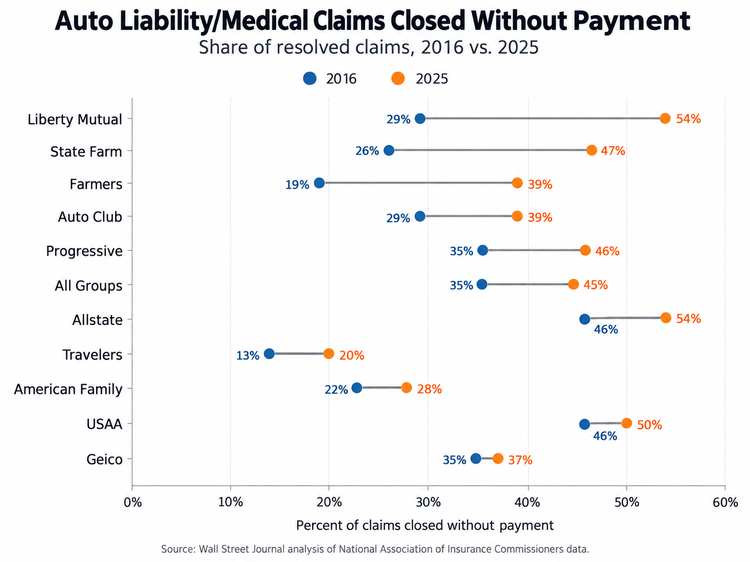
The Journal’s analysis found that nearly half of claims closed in 2025 resulted in no payment, up from about 35% a decade earlier. This trend was much less pronounced for property-damage-only claims, with liability and medical claims accounting for the growing payout gap.
When an insurer refuses to pay—or disputes the validity of a claim—working with an experienced auto accident attorney can take on added importance.
A claim closing with no payment does not always mean an insurance company acted in bad faith, but it can raise questions that should be discussed with a lawyer.
Why Are More Car Insurance Claims Closing Without Payment?
The Journal’s analysis paints a concerning picture of the current car insurance industry, noting that Americans, who got into more than 6 million crashes last year, now have about a “flip of a coin chance” of having their liability and medical claims paid after an accident.
A claim “closing without payment” is not the same as the insurer denying it. The Journal’s data additionally includes claims that were withdrawn, fell below a deductible, or involved losses the insurer said were not covered by the policy.
Insurers blame a tougher claims process on plaintiffs’ attorneys filing too many car accident lawsuits, while attorneys say they’re being scapegoated by an industry that created the problem itself by denying too many claims, continuing a classic “chicken or egg” debate between the two sides.
Consumer advocates point to denials and lowball offers as a source of extra profits for an industry that, in 2025, paid out approximately 61 cents in claims for every premium dollar collected—its best ratio since 2020.
Average car insurance premiums increased by nearly 30% between 2020 and 2025, consumer data shows. Insurance rates are also up in the first half of 2026, compounding affordability concerns.
The average annual cost for car insurance in Ohio, as of June 2026, is over $1,400. Auto insurers cite higher costs due to factors including more expensive repairs for modern vehicles and higher collision and bodily injury claim costs.
What Types of Auto Insurance Claims Are Most Likely to Close Without Payment?
The Journal found that liability and medical claims are much more likely to close without payment than claims involving damage to the vehicle itself.
- In 2025, just under one in four auto-damage claims closed without payment, a rate that has remained relatively stable over the past decade.
- Liability and medical claims, by contrast, have seen a much sharper increase in closures without payment during the same period.
Liability and medical claims tend to be more complicated, more expensive, and more likely to involve lawyers than property-damage claims. The Journal also notes that insurers have placed more “guardrails” around liability and medical claims, increasing the chances of disputes that end with no payment.
- Bodily injury claims: Claims involving injuries to drivers and passengers can become more complicated because they often involve questions about fault, the extent of injuries, medical treatment, and the amount of compensation owed.
- Medical payment claims: These claims involve medical costs arising from a crash and fall within the broader category the Journal found was increasingly likely to close without payment.
- Liability claims for damage caused to others: Liability coverage may apply when an insured driver causes damage to another vehicle or injures another person. These claims are typically more complicated and more expensive than first-party vehicle-damage claims.
- Uninsured and underinsured motorist claims: UM/UIM coverage may come into play when the at-fault driver has no insurance or not enough insurance to cover the losses. The Journal specifically identifies this coverage as part of the broader liability and medical claim landscape.
The Journal’s analysis was based on how an individual insurer’s no-payment rate changed over time, relative to its own performance and the industry collectively.
Farmers, Liberty Mutual, and State Farm had the largest increases in no-payment rates over the 10-year period. Since claims can take years to resolve, however, recent no-payment rates could decline slightly as more open claims are closed.
What the Data Means for Someone Hurt in an Ohio Car Accident
Ohioans don’t have a choice about paying for car insurance. It’s a required part of their driving responsibilities, and they must carry it in minimum amounts of $25,000/$50,000/$25,000. Many also choose to carry more through optional policies such as UM/UIM and collision coverage.
Insurers, in turn, are generally expected to pay legitimate claims covered by a policy. The WSJ article suggests these payouts are occurring less often than they used to, and that the insured are having to take extra steps to receive the coverage they expect.
One driver cited by the Journal, for example, says his claim was denied because he had failed to disclose his 15-year-old son as a household member, even though the teenager was not involved in the accident and did not have a driver’s license.
“That’s why you pay for insurance,” the driver said. “It doesn’t seem right they can just not pay.”
He is now part of a class action lawsuit against National General over its required disclosures.
While a class action could help to change an insurer’s underwriting policies or other broader practices, a specific denied or underpaid claim may require a different kind of legal action.
A car accident lawsuit often focuses on questions about who caused a crash and how it happened. But insurance disputes can also involve whether coverage applies or a claim was properly handled, or whether the insurer paid what was owed under the policy.
Not receiving an expected insurance payout can come as a shock and disappointment that sets you back financially. If that happens, it may be worth discussing with an attorney to make sure the insurer’s decision is supported by the policy terms and the facts of the claim.