

Why Was My Ohio Workers’ Compensation Claim Denied and What Can I Do Next?
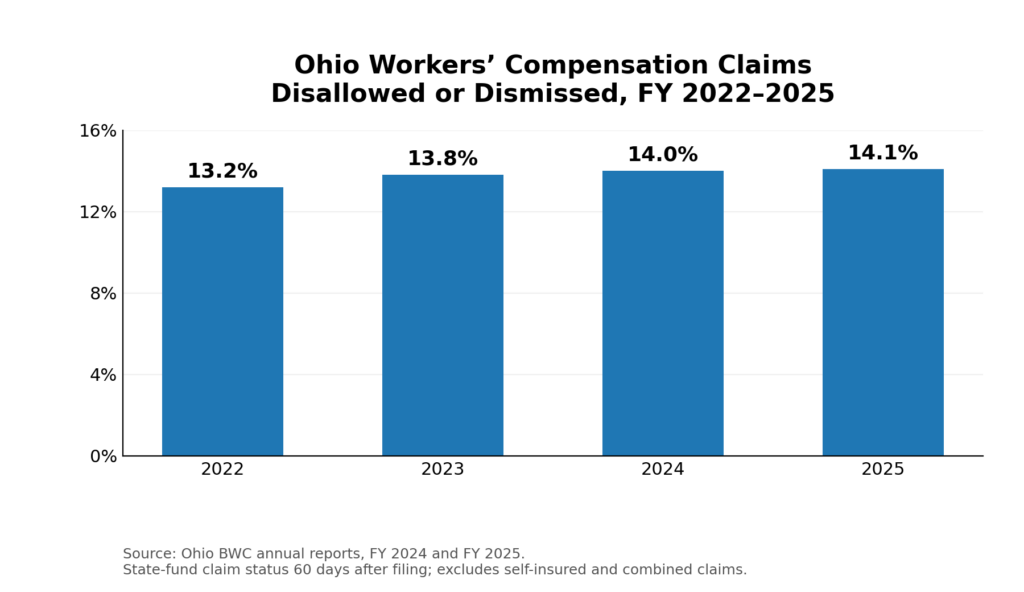
Ohio workers’ compensation is a “no-fault” system, but that is not the same as an “automatic” system in which every claim is immediately approved. In fact, around 1 in 7 filed claims in Ohio do not result in a worker receiving benefits right away.
A claim that is initially disallowed or dismissed may ultimately be approved; a denial can be just the beginning of a longer appeals process. How an appeal is approached often depends on why the claim was not approved in the first place.
If you’ve had an Ohio workers’ compensation claim denied, the stated reason may not hold up on appeal. Getting a denial overturned, however, also isn’t “automatic.” A Zanesville workers’ compensation attorney can strengthen the case for approval.
Reasons for an Ohio Workers’ Comp Denial: What the Data Says
A “no-fault” system simply means that an injured worker does not have to prove that their employer did anything wrong (or negligent) that led to the worker getting hurt on the job. There’s no need to show, for example, that an injury or illness resulted from an unsafe working condition.
Still, a workers’ compensation claim comes with procedural requirements and is not guaranteed to sail through unquestioned, as data from the Ohio Bureau of Workers’ Compensation (BWC) shows.
- According to the BWC, between fiscal years 2022 and 2025, more than 43,000 of approximately 314,000 Ohio state-fund workers’ compensation claims were disallowed or dismissed.
- That works out to roughly 14% of claims, or about 1 in 7, across four consecutive years. These figures reflect claim status 60 days after filing and exclude self-insured claims. They also may not represent final outcomes following an appeal.
Although the BWC’s 2024 report and 2025 report do not break down denials by reason, the agency’s claim determination policies identify several grounds for rejecting claims, including:
- The injury was not work-related. The BWC determined that the injury did not arise out of and occur in the course of employment.
- Insufficient medical evidence. Medical records did not adequately establish an injury or occupational disease.
- Lack of medical causation. The evidence did not sufficiently establish a connection between the diagnosed condition and the workplace incident or exposure.
- Employer disputes. The employer challenged the circumstances of the injury or disputed that it occurred at work.
- Paperwork or documentation problems. Missing information, incomplete forms, or other filing deficiencies prevented the BWC from approving the claim.
- Employment or coverage issues. Questions about the worker’s employment status, eligibility for coverage, or whether Ohio has jurisdiction over the claim.
These are documented grounds for denial, not necessarily the most frequent reasons claims are rejected. Voluntary withdrawal by a worker is one reason why a claim might be dismissed.
But the specific reason why a claim is denied matters to the appeals process. Different grounds for denial may require different evidence, explanations, and approaches to an appeal.
How Appeals Work and What to Do When a Claim Is Denied
When you’ve had an Ohio workers’ compensation claim denied, you have the right to appeal, regardless of the stated reason.
Workers’ compensation appeals are not open-ended or unlimited, though. A successful appeal requires more than just asking the BWC to reconsider. There are strict deadlines and procedures to follow that have nothing to do with “proving” an injury happened during work duties. Missing any of them could keep a claim from being approved even when the worker has satisfied the other claim requirements.
- In most cases, you have 14 calendar days from the date you receive the BWC’s written order to file an appeal. Missing that deadline can undermine your ability to challenge the denial.
- Under Ohio’s workers’ compensation appeals process, an appeal is filed with the Ohio Industrial Commission, which handles disputes over BWC decisions. You can submit an IC-12 Notice of Appeal form or file electronically through the Industrial Commission Online Network (ICON).
Once an appeal is filed, the process generally involves:
- A hearing before a District Hearing Officer (DHO). The injured worker and their employer have an opportunity to present evidence and explain their positions. The hearing officer reviews the dispute and issues a written decision.
- A possible second hearing. If either party disagrees with the DHO’s decision, they have 14 days after receiving it to appeal to a Staff Hearing Officer (SHO).
- Further appeals. A party dissatisfied with the SHO’s decision has 14 days to request review by the full Industrial Commission, but the Commission is not required to hear every appeal. Certain disputes may ultimately proceed to court.
Industrial Commission hearings are less formal than courtroom trials, but in practice, the outcome can have direct consequences for an injured worker’s medical care, lost wages, and financial stability.
Depending on the stated reason a claim was denied, preparing an appeal might entail:
- Establishing that the injury occurred at work: Gathering workplace incident reports, witness statements, photographs, or other evidence showing where, when, and how the injury occurred.
- Strengthening your medical records: Obtaining additional medical documentation, diagnostic tests, or physician reports establishing the injury or occupational disease.
- Connecting your condition to your job: Asking a treating physician to explain the relationship between your diagnosed condition and your work activities or workplace exposure. This isn’t always obvious (e.g., repetitive stress injuries).
- Responding to your employer’s objections: Collecting evidence that supports your account of the incident or addresses inconsistencies in the employer’s version of events.
- Correcting errors in your claim: Completing unfinished forms, supplying missing information, correcting inconsistent dates, or addressing other deficiencies in the initial filing.
- Verifying your employment and coverage: Providing employment records, pay stubs, job descriptions, or other documentation establishing your employment relationship or supporting your eligibility for Ohio workers’ compensation coverage.
The Industrial Commission recommends submitting supporting evidence before the hearing and encourages injured workers to attend so they can explain their case.
Injured workers also have the right to be represented by an attorney at Industrial Commission hearings. This right is expressly recognized under Ohio Administrative Code § 4121-3-09(C)(3).
Ways a Workers’ Compensation Attorney Can Help With an Appeal
A denied workers’ compensation claim can make it feel like you did something wrong that will keep you from securing benefits, when the actual reason could be a paperwork error or bureaucratic mistake. In other cases, a denial can stem from insufficient medical evidence, a jurisdictional question, or a dispute over where the injury happened.
An attorney can review the reasons for denial, identify gaps or weaknesses in the original claim, gather supporting evidence, and represent you during Industrial Commission hearings.
Legal representation may be especially valuable when an employer disputes the injury, medical causation is questioned, or the appeal involves conflicting evidence. An attorney can also advocate for you through additional levels of review, including in state court if the case proceeds that far.
Graham Law’s workers’ compensation attorneys help Ohioans hurt on the job understand their rights, challenge denied claims, and pursue the benefits state law entitles them to. Contact us to discuss a denied claim and your options moving forward.
Co-Authored by David A. Graham
Workers’ Compensation Attorney
Attorney David A. Graham has more than 30 years of experience representing injured workers in Ohio workers’ compensation matters, including workplace injury claims, benefits disputes, medical treatment issues, and workers’ compensation hearings and appeals.